Tuesday, January 21, 2014

INVOCATION


I am aware of myself,
I am aware of my radiating impact.
My heart beats with the heart of All.
I love and have faith in myself
as I navigate my self-created experiences,
and my thoughts and actions
dance and flow together inseparably.
I respect and honor my emotions and heart-felt desires,
knowing they are full-filled, in the spacious Now.
It is done, it is done, it is done,
in pleasure, ease and exhilaration.
I am each day growing closer and closer
to who I am and who I can be;
I am a dolphin jumping for joy
In the ocean of life.

Monday, November 11, 2013

Returning

As there's death in life
I find supreme life in death,
joy my old, new home. 


Friday, October 18, 2013

Is Money Necessary?


Reading some excerpts from a friend's novel, I came across this from one of his characters:  "You know the old saying: money is the root of all evil."
I commented to my friend that this was a misquote:  "It's actually: 'For the love of money is a root of all kinds of evil. Some people, eager for money, have wandered from the faith and pierced themselves with many griefs.' (1 Timothy 6:10)  Money in itself is neither good nor bad."

In literature, Scrooge in Dickens' A Christmas Carol is an example of the "many griefs" that can ensue when overconcern with money eclipses our humanity and fellow-feeling, and Fitzgerald's The Great Gatsby portrays the Lost Generation and the emptiness of wealth without the compass of solid values.

Mark Boyle, author of The Moneyless Man and The Moneyless Manifesto, is one who seems to subscribe to the "old saying" and who has thus chosen to live without money.  After studying economics for six years in college, he was inspired by the movie "Gandhi" to be the change he wanted to see in the world. He decided that meant he would have to give up cash, initially just for one year, and this stretched out to five. He refers to money as "that soulless, empty, arbitrary concept" that is useless for providing our basic needs. "We are completely delusional about what we need in order to live nourished, meaningful lives...As the Cree Indian proverb goes, it seems that 'only when the last tree has died, the last river been poisoned and the last fish been caught, will we realize we cannot eat money.' "

In contrast to Boyle's perception of money as a delusion, in David Cameron's book A Happy Pocket Full of Money, he calls it "an illusion, a shadow of something else...It is all just numbers written on paper and computer storage devices and assigned to people and entities like companies and investment groups — or, more accurately, further illusion!...The only reason this system does not collapse is that we all believe in it."  He says we should not look at the shadow, the illusion of money.  Rather, it's about developing internal value, or wealth consciousness, which he says "is available to all people equally...Like everything else that is important to our being alive — like air — wealth consciousness is free to all. But you can choose to develop it or not, or to exercise it or not."  He defines wealth consciousness as "simply the expansion of your consciousness and awareness into the wealthy parts of your Self...You are already wealthy, but you have been taught to choose not to experience your wealth."

 Since most wars and wasting of the Earth's resources come about through our belief in scarcity (or as Swami Beyondananda calls it, "scare city"), they will end when we are truly in touch with our inner riches, and when we believe in the possibility of abundance for everyone.  The outer reality reflects the inner,  and as this belief gains ground and becomes widespread, so will  unlimited, free, and sustainable energy technologies become available. And it all starts with each one of us, here and now.

We may need to redefine wealth or what it means to be rich.  Is it about winning millions in the lottery, or is it about having "enough"?  I think having enough is about being able to follow our chosen path, without wasting energy in worry -- whether it's worry about taking care of our basic needs, or on the other hand, about dealing with huge amounts of money. Of course, we are all different,  and some, like Mark Boyle, will feel abundant with much less or no money. He said that his first year of living cash-free was "the greatest experience of my life." He  is following his natural bent, doing his life's work.  Even without money, he is wealthy in his own way.  Others may need a lot of money and material possessions to feel on track and fulfill their purpose.  The important thing is to  be happy with our lives, comfortable with ourselves and with what we have, while staying open to our dreams, and following our heart.

In one of the parables of Sri Ramakrishna, there is the story of a woodcutter who was asleep and dreaming. When a man awakened him, he was greatly annoyed.  "Why did you wake me? I dreamed I was a king, I and my children had everything, I was on the throne and ruling over my country.  You destroyed my kingship!"  "Oh, it was only a dream," replied the man. "What's the problem?"

The woodcutter was further angered, but inspired to an important insight: "Get away from me, fool! My dream of being a king was just as real as my dream of being a woodcutter."

If the woodcutter could continue to feel the reality he experienced of his king state, he would, more and more, see this in his waking dream. We all need to do the same.  Gold-diggers get a bad rap, but I propose we become gold-diggers of our consciousness, embracing and living our golden dreams, in whatever form they play out for us. And somewhere, a king may be dreaming about being a woodcutter...

I also propose cultivating a "trust fund," simply trusting in our own life energy to meet our needs and guide us into right action.   This trust fund is one that will always be there for us and never run out.  To quote the shortest poem I ever wrote:

WORDS TO LIVE BY
Just
trust.

"Love is the only gold," said Tennyson. And love is not just about personal relationships.
As adults, many of us need to get back the zest and love of life we had as children. Hopefully, we aren't just existing, not just passing time here on planet Earth. Life can be a love affair with All That Is, with who we are and who we can be.  How can we put a price on that?


Sunday, May 19, 2013

A TASTE OF MANZANITA HONEY


A TASTE OF MANZANITA HONEY
(Raw--Unfiltered)

I know I'm in trouble
when I start to identify
with the ants that keep trying
to get into the honey jar.

I've found a few
who made it,
tiny black corpses,
floating in their golden heaven.

Sighing, I scoop them out,
wipe the jar,
put it on another shelf.
They won't find it for a while.

Maybe those dead ants
are the lucky ones.
I, too, sometimes feel
I would die for a taste
of something sweet,

and so I eat chocolate
or take a drink
or watch a show
or have a toke,

and I wonder who keeps moving
the golden dreams.

Friday, March 29, 2013

The Divine E. Bunny


My son Ben told me
his Christian friends,
hoping to save his soul,
asked him to Easter services
at their church. But he,
learning there would be
no Easter egg hunt,
politely declined.

I explained to him

about the organized church
of the Divine Bunny
and the factions therein:
those who hunt
the chocolate fudge eggs,
those who search for
the painted hard-boiled eggs,
and those who pray to find
the pink, yellow and blue
candy eggs, nestled in bright green
faux grass, in the wicker baskets
of many colors.

Then I said: but the real Bunny

encircles the Earth,
and we are all His congregation.
He knows " what's up, Doc,"
he knows our deepest longings
which he has already given
and are just waiting to be found.

Yes, Benjamin, my son,

there is an Easter Bunny,
a Santa, a Jesus,
and a God
of uncounted names.
They rove our world,
hiding treasures to delight
and enlighten,
sacraments of the senses
and the soul,

in the sweet-scented grass,

in the Wonderland that waits for us
down the rabbit hole.

Friday, February 15, 2013

The Trial: Flight From Self


In The Trial by Franz Kafka, Josef K. is put "on trial" for an unnamed offense. Prior to this, conflicts and inconvenient desires are ignored, festering under the bland surface of his rigid, routine existence, where even his visits to his mistress take place on the same day each week. The trial brings those conflicts out into the open.

K's plight worsens the more he shies away from taking responsibility for himself. He represses a strong feeling of guilt which emerges abruptly at decisive moments, while in court, he denies all guilt until the very end. To Miss Burstner he says: "Your room was thrown into disorder a bit this morning, through my fault to a certain extent--it was done by strangers, against my will, and yet, as I said, through my own fault." The "strangers" in question are the warders, who are whipped by the authorities following K's accusation, and he cries out, "I do not consider them to be guilty at all; it is the organization that is guilty, it is the high officials that are guilty." What is more, "it would have been almost simpler if K. had taken off his clothes and offered himself in place of the warders." And on the following day, he closes the door to the lumber room where they are being whipped, "hammering against it with his fists as if it would be shut tighter that way." His ultimate reaction to anything that doesn't fit his heretofore tidy, cloistered way of life is to deny and "shut the door" on it. He wants the lumber room cleaned out: "I tell you, we're being drowned in filth!" Conflicts, irrational incidents are experienced as overwhelming filth that must be thrown out, rather than faced and worked through.

Josef K. is very attracted to Miss Burstner, but is passive in relation to her. She has little "experience in legal matters", but she "would like to know everything, and legal matters, particularly, interest me very much. A court of justice has a particular attraction, don't you think?" She is "inordinately disappointed" that K. himself does not know what his prosecution is all about. The "court of justice" here represents the law of Josef K's inner being, or soul-self. Since he fears and in fact flees from that self, he is unable to have a truly intimate relationship with another person.

K.is in a rage at his arrest, but at the same time, he succumbs: "He harbored the intention...of offering himself up to them for arrest." He sees the situation as a "comedy", and at the same time, it gives rise to thoughts of suicide that recur throughout the novel.

His first impulse is to deny any wrongdoing, proclaiming that he has been falsely accused. He can only think of struggling against the forces threatening him. In the face of such external blows, he has not developed the kind of unassailable inner freedom and security that Kafka spoke of in Reflections on Sin, Suffering, Hope, and the True Way: "The fact that only one world of the spirit exists, takes hope from us and leaves us certainty."

K's conversation with the priest in the cathedral illustrates this concept of spiritual independence. They agree that his case is "going badly", and the priest asks him what he proposes to do about it. K's answer is: "I'm going to get more help...There are several possibilities I haven't explored yet." "You cast about too much for outside help," said the priest disapprovingly. "Don't you see it is the wrong kind of help?" K. then makes a derogatory remark about the character of the men in court, calling them "petticoat-hunters,"and the priest loses patience: " 'Can't you see even one pace in front of you?''...It was an angry cry, but at the same time sounded like the unwary shriek of one who sees another fall and is startled out of his senses." The priest then relates the parable "Before The Law." In this parable, there is the possibility that the man from the country can enter the door to the Law (which is his God-self, the Law of his Inner Being) after his death; what is more, he could have entered it during his lifetime, had he asked earlier for whom the entrance was actually intended, instead of waiting until he was at the point of death. Then he would have received the "redeeming message": the door was meant for him all along.

K., in plotting how to get "help," puts himself in the position of the man from the country pleading with the doorkeeper to let him in. As the man from the country is fixated on what he thinks of as the ultimate power of the doorkeeper, so K is fixated on the idea of getting help from others who he imagines to be "in the know," somehow more able than he to solve his problems. He has hopes that the priest will be able to help him: "...it was not impossible that K. could obtain decisive and acceptable counsel from him which might, for instance, point the way..." But at the end of their meeting the priest also identifies himself as a member of the Court, and once again K. is thrown back on himself.

K. comes to feel it is his "duty" to execute justice upon himself, but as he is never clear about the details of this, he is executed in a "play" put on by puppet-like "tenors" and "supernumerary actors." In the end, he is assailed with questions:


Like a sudden blaze of light, the casements of a window flashed open there; a human being, faint and tenuous in the distance and at that elevation, suddenly leaned far forward and stretched his
arms even farther out. Who was it? A friend? A good person? Someone who was concerned? Someone who wanted to help? Was it a single individual? Was it everybody?


Josef K. does not know the answer to these or the other questions raised by his trial; he has not attained certainty within himself. But, even as the man from the country in the parable "Before The Law" may be able to enter the door to the Law after his death--for the "portal of the Law is always open...always, that is, irrespective of the duration of life for the man for whom it is ordained, the doorkeeper will not be able to close it"--so too, perhaps, Josef K. may attain certainty after his death. He has made progress; he has been forced to look into himself, has learned that there are important questions, and he yearns to know the answers.

Friday, February 1, 2013

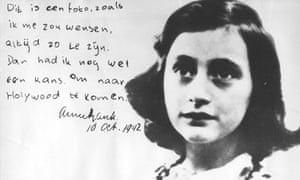
Anne Frank Speaks


[…] I get cross, then sad, and finally end up turning my heart inside out, the bad part on the outside, and the good part on the inside, and keep trying to find a way to become what I’d like to be and I could be…if only there were no other people in the world. (8/1/1944.6)

I am a young girl still, yet no age at all,
and I have learned some things.
I know I have always been free
to be all I can be,
to soar with the birds of the soul
even as we hid ourselves away
and hardly dared to play,
tiptoeing around, afraid to make a sound,
lest we be heard downstairs.
I see that all I've lived
has been part of me.
and I know, beyond doubt,
there are no "other people" in the world
or anywhere,
for my heart is still turned inside out
and I see them there,
sharing, living, loving, free,
my heart, my part,
dancing here upstairs with me.